Government Idiocy and how not to manage a project

60 Minutes had a great segment Sunday night about a "Virtual Fence" project that's being conducted along the US/Mexico border. The idea is that there's a host of motion detectors, cameras, and other gadgets that can identify people trying to cross the border. Once spotted, border patrol can be deployed to "intercept" people before they get in.

The problem?

The people building the system didn't actually talk to the border patrol. You know, the people that would actually use the system. They basically built it in a silo, didn't talk to users, didn't iterate, and shipped a product that doesn't really work. Oh, by the way, you and I paid for it.

I'm sure they had a lot of fancy documents though.

Hey, US Government, if you need help getting this thing straightened out give me a call. My number is 773.932.1138.

Check out the absurdity below:


Watch CBS News Videos Online


Podcast Episode Three - Interviewing the Director of Human Rights Projects

Daniel Rothenberg is the Managing Director of International Projects for the International Human Rights Law Institute at DePaul University's College of Law, and he was kind enough to join me for Project Idealism's second full podcast.

Daniel oversees numerous Human Rights projects, and in this episode the primary topic of our discussion is The Iraq History Project.  Taking a victim centered approach to documenting various Human Rights violations under Saddam Hussein’s regime, this project is one of the largest independent human rights data collection and  analysis projects in the world

We discuss how a project of this size got going, how interviewers were recruited and trained, how the stories of victims were shared, and how that information was carried through Iraq - often times without power and always without internet access - to offices in Northern Iraq.

Daniel shares some fascinating information about the specifics of their project and provides numerous lessons not only for project managers or those in business, but anyone interested in how amazing people do amazing work.

Daniel has been a guest on NPR's Worldview, and is also the author of With These Hands: The Hidden World of Migrant Farmworkers Today.

I truly can't thank Daniel enough for his participation with the Project Idealism podcast.

Let's try this again shall we?

Readers of this blog know that back in November I started a new company called Duarlander, and wrote about it in a post titled The Birth of a new company.

Since that time we've learned a lot and have made some major changes. We basically reinvented everything about what we're doing with the company and are working to create a community of developers and testers.

The full story behind the changes can be found in this blog post, and if you took a minute to read what we did I would really appreciate it.

If you know anyone with an Android phone, let them know there's now a way they can make money just by testing out the latest and greatest applications. And if you know any Android developers, we'd love it if you could send them on over to Duarlander to get their applications tested.

Understanding your place on Rogers' bell curve

A couple of the things I've learned about from some of the people I mentioned in this post are the technology adoption life-cycle and the Rogers' bell curve. Click on the image, courtesy of Wikipedia, for a sharper graphic:
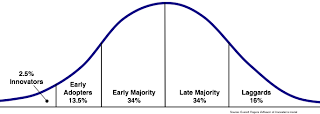


* This image published in accordance with terms of the GNU Free Documentation License, is licensed under the Creative Commons Attribution-ShareAlike 3.0 License, and the Creative Commons Attribution 2.5 License.

The links above provide more detail, but the brief summary is that ideas spread through a population first by reaching innovators, then early adopters, then the early majority and so on. Sometimes ideas make it out of the "innovator" group and other times they don't. It is the ability of an idea (or a product, service, etc) to move into the early majority and the late majority categories that cause it to become mainstream.

Most of what I've read and heard about generally seems to be in the context of understanding your place on this curve for the various things we consume, whether your idea could flow through the population, and who you are creating things for. You may, for example, only want to create something for innovators or laggards/very late adopters.

It seems that there's a much less often discussed (although it's certainly possible I've just missed the discussion), but very important aspect of looking at this curve and understanding where you fall on it from a creative and innovative standpoint. This is something I've been thinking about a lot lately, and I think it can help us figure out how we can all start creating something right now, if we want to.

Let's take my mother as an extreme example - she is comfortable checking email and surfing the web a very little, and learned to use Skype because it allows her to see and talk with her grandchildren even if she's far away. That's about the extent of her knowledge on how to use the internet. If she were to decide to start a new company, where would she be more likely to succeed - teaching the elderly how to use email, or trying to teach high school kids how to use WordPress?

Her innovative energy, right now anyway, would be better spent on creating something for those who are a little further to the right on Rogers' curve from where she currently resides. To me, my mom may not be a technology innovator. But to a grandparent living in Florida who just learned how to use Skype, she might be the most tech savvy person they know.

You don't need to be an "innovator" on Rogers' curve in order to create something.

The other benefit of understanding where we fall on this curve is that it can help us direct our energy in the right place. Let's take someone at the other end of the spectrum from my mother, say at the front end of early adopters. If with just a bit more energy (learning a new programming language, understanding a new design concept, etc.) they could dramatically increase their innovative potential then maybe that's where they should be focusing their energy. Maybe they shouldn't try to create something for all those people to the right of them quite yet.

It's up to each of us individually to figure out how and where to spend our innovative energy.

One thing that seems to be true in any case though, is that as we begin to create things, we move further to the left on this curve. The process of creating and teaching requires us to learn and understand more about technology. In turn, we reach another level at which we're able to innovate and there's another group of people that we can help.

This process however, at least with me, can create an internal struggle. I realize now for example, in a way I hadn't before, how closely intertwined design and technology are, and I think I'm definitely further to the right on Rogers' curve from a design standpoint than say an "internet" standpoint.

There are times when I come across or am introduced to a website like FictiveKin or Sofa and I feel like running and hiding. How dare I put something like the Duarlander or the GoFind! sites on the same internet as them! And I seriously wonder, would they be mad at me for making their internet less beautiful?

The things is, we have to practice, and the nature of the internet requires that we practice publicly.

So the best I can tell is that if we're honest with ourselves about where we are on this curve, then there is someone for whom we can create something. And as long as we're trying to learn from the people to the left of us, then we're respecting what they've created so far. We're simply playing our natural role in the evolution of an idea - and conscious that we don't want to ruin anyone's "favorite slice of the web" as Seth Godin wrote about in this post.

I think this is a pretty good place to be.

Update

I feel like I should mention, when I was talking about the Duarlander site above, I was referring to the old one. I'm very happy with the new one and think it's really awesome.

The GoFind! one's pretty decent too, my point was simply that there are some others on a different level entirely.


A year of inspiration, action, tragedy, fear, hope, and love

A lot happened in my little world in 2009. As I look back, I realize the things I remember the most, and the events that have impacted me, are because of the people who have touched my life in one way or another. Some are family, some friends, some people I've met only once and others I've never even met. I thought it would be nice to enter 2010 by taking a moment to look at the people that had such an affect on my 2009.

I simply can't begin this post without writing about my cousin Cameron. He had just received his bachelors degree, when a few weeks after graduation he was killed in a bus accident. Our family was changed forever. Prior to his death, Cameron registered to be an Organ Donor and his heart, lungs, kidneys, liver and other organs have saved numerous lives. Cameron lived his life fully and he was truly loved by a lot of people.

His death is a reminder that life is fragile; that what we do with the time we do have matters. That very few things in this world are permanent, and that behind everything we're doing, what matters to us all the most are the relationships that we have with other human beings.

A website has been set up as a tribute to Cameron's life and can be found at CameronChana.org. If you would like to register as an organ donor, you can do so for any state in the United States at DonateLife.com. It takes only a minute, and it's a way you can help Cameron continue to impact people even after his passing.

--------------------------

Jason Fried and 37Signals have been a huge inspiration to me. They make a project collaboration software called basecamp (along with three other products) and it is without any doubt my favorite software to use when managing a project. I often joke with people that in an ideal world we wouldn't even need project managers, and I think Basecamp actually brings that reality a little closer.

Some people think I'm a fanboy, but I think they've created something revolutionary that has changed my profession for the better. They also wrote a book called Getting Real that's about software development and we applied a lot of what they teach when we built GoFind. I believe every project manager should read Getting Real, and they have another book coming out in March titled ReWork that looks like it will be awesome as well. They preach a gospel of simplicity with a focus on superb design, and advocate vigorously the advantages of being a small business and working with small businesses.

--------------------------

Because I thought so highly of Basecamp, I started learning more about the people and the company behind the product. By way of following Jason Fried on twitter I learned of Derek Sivers. Derek founded a company called CD baby to help independent artists sell their music. He later sold it, but not before giving the company to a foundation he started to promote music education. His blog at sivers.org is a treasure chest full of great information that could benefit just about anyone.

--------------------------

Seth Godin is a marketing genius and as sure as the sun comes up in the morning there's a blog post in my feed reader from him. I had first heard of Seth Godin when a book he wrote titled Purple Cow came out, but it wasn't until this year that I really became engaged in what he was saying. I went to a seminar that I wrote about back in November, and it had a significant impact on the way I view business, marketing, social media, and a whole host of other things. Seth Godin has written over 10 books, and has another one coming out this month called Linchpin: Are you indispensable? I have read about half his books and will continue to read them until I have finished them all.

--------------------------

I don't even remember how I first heard of Dragos Roua, but I'm pretty sure it was by clicking through random people on Twitter and I stumbled across him. I've followed his blog pretty regularly for a few months now, but there was one post he wrote titled How to be Ridiculous that was exactly what I needed to hear at exactly the right time. I'll never forget it.

--------------------------

Mike Shedlock is the author of Mish's Global Economic Trend Analysis and a wonderful source for economic news. While I don't agree with everything he writes, I've never questioned his honesty and he's become one of my most trusted sources for economic news.

--------------------------

The anonymous writers at ZeroHedge have been talking truth to power in a way unlike any others I've read. They produce so much good material that it's nearly impossible to keep up with their feed. They've uncovered a whole mess of things related to the economy, government, and politics and teach us all how powerful a free voice can be.

--------------------------

I'm very grateful for all the work that Theresa Valdez, Camri McAvoy, RedDroid Software, and Michael Maitlen did to make GoFind a reality. We released our first version in just 5 and 1/2 weeks and continued to tweak things over the course of another 5 releases. We're not done with GoFind yet, but getting it out and having my first product out in the world felt really great. I still remember jumping up and down on the roof of my building like a little kid the very first time it worked the way I envisioned it.

--------------------------

My father who overcame a brain tumor, and my mother who has been with him every step of the way, teach me constantly what it means to love the people in your life.

--------------------------

My family - Maile, Leila and Kai - are the most important people in the world to me. Unless everything is all right with them, none of the other stuff I've talked about in this post matters. A lot of times people in business talk about family and kids as if they were burdens that prevent us from doing great things and reaching for our dreams. I don't feel this way. I'm grateful for every minute that they're with me on this journey through life and wouldn't have it any other way.

A sincere thanks to everyone for making 2009 so extraordinary, and I can only hope 2010 brings the same amount of inspiration - but with none of the tragedy.

Happy new year.